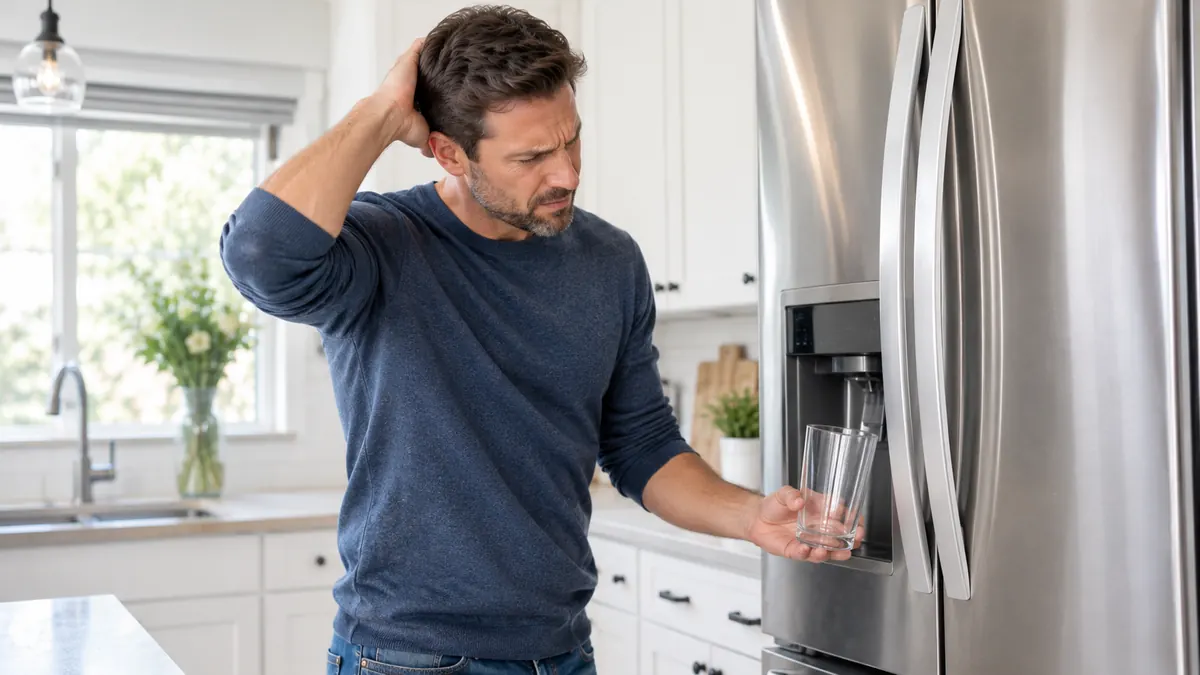
You press the glass against the dispenser, the motor hums, and nothing drops. Or you open the freezer and the ice bin is empty again.
An ice maker not working is one of the most common refrigerator complaints. The rest of the refrigerator may cool normally while the ice maker makes no ice, makes very little, or produces small and hollow cubes.
In this guide, we’ll explain why an ice maker stops making ice, what you can safely check yourself, which symptoms point to which cause, and when the problem needs a technician.
Why Is My Ice Maker Not Working?
An ice maker needs three things to work: it has to be switched on, the freezer has to be cold enough, and water has to reach it. Most problems come down to one of these.
Ice Maker Is Switched Off
A raised shutoff arm, an Ice Off setting on the display, or a small switch on the ice maker itself will stop production completely.
Freezer Is Not Cold Enough
Most ice makers need the freezer at or near 0°F (-18°C). If the freezer runs warm, the ice maker waits and does not start a new cycle.
Water Is Not Reaching the Ice Maker
A closed shutoff valve, a kinked supply line, a clogged filter, or a frozen fill tube keeps water from filling the ice mold.
The Ice Maker or Inlet Valve Has Failed
If power, temperature, and water supply are all normal, the water inlet valve or the ice maker assembly itself is the likely fault.
What to Check First When the Ice Maker Stops Making Ice
These checks need no tools and do not involve taking the refrigerator apart. Work through them in order.
Make Sure the Ice Maker Is Turned On
Lower the metal shutoff arm if your model has one, check for an on and off switch on the ice maker, and confirm that the display does not show Ice Off. If the dispenser controls are locked, check the owner’s manual for the correct way to unlock them.
Check the Freezer Temperature
Set the freezer to 0°F (-18°C). If the food in the freezer is soft or the freezer feels warmer than usual, the ice maker is not the main problem.
Test the Water Dispenser
If your refrigerator has a water dispenser, fill a glass and check the flow. A weak or slow stream may point to a clogged filter, a restricted water supply, or low water pressure. Normal flow does not rule out an ice maker problem, because some models use separate water paths for the dispenser and the ice maker.
Replace an Old Water Filter
Many manufacturers recommend replacing the water filter about every six months. The actual interval depends on the model, the water quality, and how much water you use, so follow the filter indicator or the schedule in the owner’s manual. A clogged filter is a common reason for small cubes or no ice.
Check the Supply Line and Shutoff Valve
Look behind the refrigerator for a kinked or pinched water line, and make sure the shutoff valve on the supply line is fully open.
Empty the Bin and Clear Stuck Cubes
Remove the ice bin, break up or discard clumped ice, and check that no cube is stuck in the ice maker. Then put the bin back fully in place.
After any change, give the ice maker time. A newly installed or reset ice maker can take up to 24 hours to fill the bin again.
Never use a knife, screwdriver, ice pick, or heat gun to remove stuck ice. These tools can damage the ice maker, the water lines, and the freezer liner. If ice has frozen around the ice maker or the fill tube, follow the manufacturer’s defrosting instructions or have the problem inspected by a technician.
8 Reasons an Ice Maker Stops Working
If the basic checks did not solve it, one of these causes is likely. Several of them produce the same symptom, which is why testing matters before any part is replaced.
1. Ice Maker Turned Off or Paused
The shutoff arm can be bumped up by a bag of food, and a control panel setting can be changed by accident. Either one pauses ice production.
2. Freezer Running Too Warm
A door left ajar, a worn door gasket, blocked air vents, or a cooling problem keeps the freezer above the temperature the ice maker needs.
3. Clogged Water Filter
A filter past its service life restricts the water flow. The ice mold fills only partly, so cubes come out small, hollow, or not at all.
4. Kinked Line or Low Water Pressure
A pinched supply line, a partly closed valve, or low household water pressure means the inlet valve cannot deliver enough water.
5. Frozen Fill Tube
The fill tube carries water into the ice mold. It can freeze when water drips into it slowly and freezes between cycles. A leaking inlet valve, incorrect water pressure, or another water supply problem can contribute to repeated freeze-ups.
6. Faulty Water Inlet Valve
The inlet valve opens to let water into the ice maker. It can fail electrically, clog with mineral deposits, or stop closing fully and drip.
7. Failed Ice Maker Assembly
The motor, the heater or twist mechanism that releases the cubes, and the sensors inside the ice maker wear out. When one fails, the cycle stops partway.
8. Ice Dispenser or Auger Not Working
The ice maker may be producing ice normally, but clumped cubes, a jammed auger, or a dispenser motor problem can keep the ice from reaching the dispenser chute.
Frost and ice in the wrong places often go together with ice maker problems. Our guide to freezer ice build-up explains where that frost comes from.
Freezer Ice Maker vs. In-Door Ice Maker
Where the ice maker sits changes which problems are most likely.
Ice Maker Inside the Freezer
Common on top-freezer, side-by-side, and bottom-freezer models. It relies on the freezer temperature directly.
Possible faults:
- Shutoff arm raised
- Freezer too warm
- Frozen fill tube
- Failed inlet valve
- Worn ice maker assembly
Ice Maker in the Refrigerator Door
Common on French door models. The ice maker sits in an insulated compartment that is cooled by its own air duct.
Possible faults:
- Frost blocking the ice compartment
- Air duct or fan problem
- Leaking compartment door seal
- Jammed ice bucket or auger
- Failed ice maker or sensor
An in-door ice maker that keeps freezing into a solid block usually has an air leak or a defrost problem in the ice compartment. Thawing it brings the ice back for a while, but the freeze-up tends to return until the cause is repaired.
Ice Maker Not Working: Symptoms and Likely Causes
Use this table to connect what you are seeing with the most likely cause and the next step.
| Symptom | Possible Cause | Recommended Action |
|---|---|---|
| No ice at all | Ice maker off, no water supply, frozen fill tube, or failed ice maker | Check the setting and the water supply. If both are normal, schedule a repair. |
| Small or hollow cubes | Clogged filter, low water pressure, or weak inlet valve | Replace the filter and check the supply line. |
| Ice maker hums or buzzes but no water fills | Closed supply valve, frozen fill tube, or failed inlet valve | Confirm the valve is open, then schedule a repair. |
| Ice clumps together in the bin | Warm freezer, door seal leak, or ice that melted and refroze | Empty the bin and check the freezer temperature and door seal. |
| Water or a sheet of ice under the ice maker | Dripping inlet valve or misaligned fill tube | Turn the ice maker off. If water keeps leaking, close the refrigerator’s water supply valve. Schedule a repair. |
| Ice in the bin but nothing dispenses | Clumped ice, jammed auger, or dispenser fault | Break up the clumped ice. If the auger does not turn, schedule a repair. |
| Ice tastes or smells bad | Old filter, old ice, or uncovered food | Replace the filter, discard the old ice, and clean the bin. |
| Error code on the display | Brand-specific fan, sensor, or ice maker fault | Write down the code and share it when you book service. |
If your refrigerator shows a code, our brand guides can help you read it: see the GE refrigerator error codes and the Samsung 22E error, which is linked to ice buildup around a fan. On LG models, the Er IF code points to the ice compartment fan.
When Does an Ice Maker Need Professional Repair?
If the ice maker is on, the freezer is cold, the filter is fresh, and water reaches the refrigerator, the remaining causes are inside the appliance and need testing.
Schedule Service If You Notice Any of These
- No ice after 24 hours with the settings and water supply confirmed.
- Water dripping inside the freezer or onto the floor.
- The ice maker freezes into a solid block again after you thaw it.
- The freezer or refrigerator section is also warmer than normal.
- The ice maker runs through its cycle but no water enters the mold.
A warm freezer changes the diagnosis. If the fresh food section is warm too, read our guide on a refrigerator not cooling. If you see water on the floor, see water leaking from the refrigerator.
A technician can test the inlet valve and the ice maker, check the fill tube and the air path, and confirm the cause before replacing parts. Our refrigerator and freezer repair service covers ice makers on models from Samsung, LG, GE, Whirlpool, and other major brands.
Is It Worth Repairing an Ice Maker?
Usually, yes. The ice maker is a separate assembly, and replacing it or the inlet valve costs far less than replacing the refrigerator.
The decision changes when the ice maker problem is a sign of a larger cooling fault.
Repair Usually Makes Sense When
- The refrigerator and freezer cool normally.
- The fault is the ice maker, the inlet valve, or the fill tube.
- The refrigerator is otherwise in good condition.
- It is a built-in or higher-end model.
Replacement May Make More Sense When
- The refrigerator also has repeated cooling problems.
- The sealed system or compressor is failing.
- Parts for the model are no longer available.
- Several major repairs have been needed in a short time.
For a wider look at this decision, see our guide on whether to repair or replace an appliance. Regular care also helps, and our refrigerator maintenance tips cover filters, coils, and door seals.
Ice Maker Not Working: Frequently Asked Questions
Why did my ice maker suddenly stop making ice?
The most common reasons are an ice maker that was switched off by accident, a clogged water filter, a frozen fill tube, or a freezer that is running too warm. Check those before assuming a part has failed.
How do I reset my ice maker?
The method depends on the brand and model. Some ice makers have a reset or test button, others reset when switched off and on. Follow the owner’s manual for your model, and allow up to 24 hours for ice afterward.
Why is my ice maker not getting water?
Water can be stopped by a closed supply valve, a kinked line, a clogged filter, a frozen fill tube, or a failed inlet valve. If the water dispenser also runs slowly, start with the filter and the supply line.
How cold does the freezer need to be to make ice?
Most manufacturers recommend 0°F (-18°C). If the freezer runs noticeably warmer, the ice maker may slow down or stop cycling.
Why are my ice cubes small or hollow?
The mold is not filling completely. A clogged filter, low water pressure, or a weak inlet valve is the usual cause.
How long does it take an ice maker to make ice?
After installation or a reset, some ice makers need up to 24 hours to start filling the bin. In normal use, the production speed varies by model, freezer temperature, and how often ice is dispensed. The owner’s manual lists the expected rate for your model.
Why does my ice maker keep freezing up?
Repeated freeze-ups point to a dripping inlet valve, a fill tube problem, or warm air leaking into the ice compartment. Thawing helps for a short time, but the cause needs repair.
Can I still use the refrigerator if the ice maker is broken?
Yes, as long as the refrigerator and freezer cool normally and nothing is leaking. Turn the ice maker off until it is repaired. If water is leaking, close the supply valve as well.
Ice Maker Still Not Working? We Can Help.
If your ice maker makes no ice and the basic checks have not solved it, North Appliance Service can find the cause and repair it.
We diagnose ice maker assemblies, water inlet valves, frozen fill tubes, dispenser problems, and ice compartment freeze-ups on refrigerators from most major brands.
Serving Seattle, Bellevue, Kirkland, Redmond, Bothell, Sammamish, Lynnwood, Everett, and nearby communities in King and Snohomish Counties.
Safety note: Ice maker controls, reset procedures, and water connections vary by manufacturer and model. Always follow the owner’s manual. Follow the manufacturer’s instructions for defrosting, and never use sharp tools or high heat on the ice maker or the freezer liner.